Parking a semi-truck is one of the most important skills a professional truck driver can develop.
A tractor with a 53-foot trailer is much longer and less maneuverable than a passenger vehicle, and the driver cannot see everything around the truck at the same time. Tight truck stops, crowded distribution centers, narrow loading docks, poorly marked parking areas, and limited visibility can turn a simple parking maneuver into a difficult situation.
For new CDL drivers, backing and parking can be especially stressful. The good news is that these skills improve significantly with practice.
The most important rule is simple: never rush a parking maneuver.
Taking an extra minute to reposition the truck, check your mirrors, or get out and inspect the area is always better than damaging another truck, trailer, building, or your own equipment.
Here are practical tips that can help you park a semi-truck more safely and confidently.

Why Is Parking a Semi-Truck Difficult?
A typical tractor-trailer creates several challenges that passenger-car drivers rarely have to consider.
These include:
- A long wheelbase
- A trailer that moves differently in reverse
- Large blind spots
- Limited rear visibility
- Trailer swing
- Tractor swing
- Tight parking areas
- Vehicles parked on both sides
- Pedestrians around truck stops
- Poor lighting at night
- Obstacles that may not be visible from the cab
When moving forward, the trailer generally follows the tractor.
Backing is different.
The driver's steering inputs change the angle between the tractor and trailer, and even a relatively small steering movement can cause the trailer to move significantly.
That is why successful backing requires patience, frequent mirror checks, and small corrections.
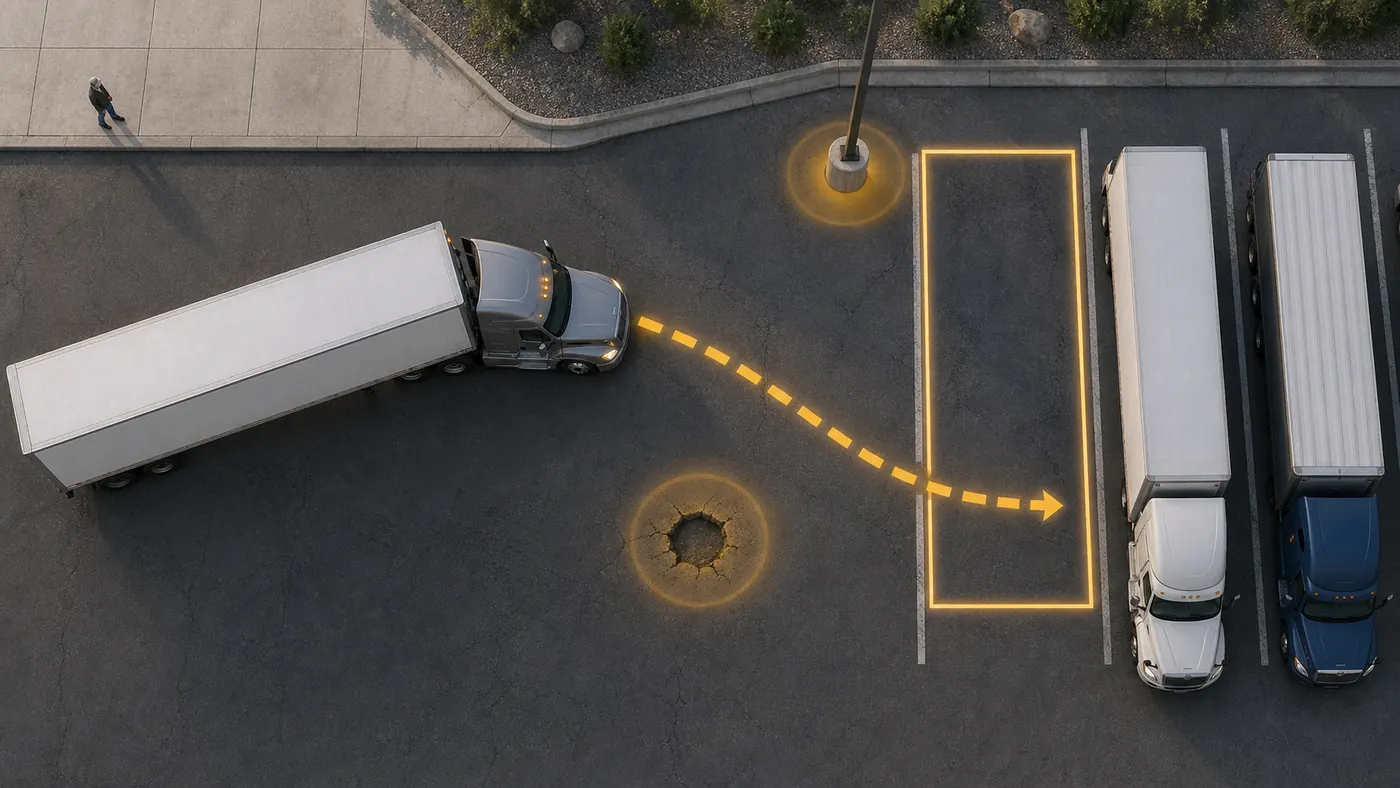
1. Inspect the Parking Space Before Backing
Before attempting to park, look at the entire area.
Do not focus only on whether the parking space appears wide enough.
Look for:
- Other trucks
- Trailers
- Cars
- Pedestrians
- Curbs
- Concrete barriers
- Light poles
- Signs
- Fire hydrants
- Shopping carts
- Low tree branches
- Overhead structures
- Potholes
- Uneven pavement
Also check how much room you have in front of the parking space.
You may have enough space between two trucks but not enough room to swing the tractor into position.
Whenever possible, drive past the space first and inspect it from multiple angles.
Commercial driver manuals emphasize checking the intended backing path and clearance around the vehicle before beginning the maneuver.
2. Use GOAL: Get Out And Look
One of the most useful habits in trucking is commonly known as GOAL — Get Out And Look.
If you are not sure where the trailer is, stop.
Secure the truck and physically inspect the situation.
Look at:
- Distance from neighboring trucks
- Trailer position
- Rear clearance
- Tractor clearance
- Obstacles
- Trailer tires
- Parking-space lines
Getting out may feel unnecessary when you are almost finished backing.
That is often exactly when it is most valuable.
A driver may have excellent visibility on one side of the trailer while being only a few inches away from an obstacle on the other side.
Official CDL guidance recommends getting out and checking the vehicle's path whenever the driver is uncertain about clearance.
When exiting the cab, properly secure the vehicle first. CDL testing guidance also emphasizes setting the parking brake before leaving the driving position.
Never be embarrassed to GOAL.
Experienced drivers use it too.
3. Back as Slowly as Possible
Speed creates problems during backing.
The faster the truck moves, the less time you have to:
- Notice an obstacle
- Recognize trailer drift
- Correct your steering
- Stop before contact
Back slowly enough that you can stop immediately if something looks wrong.
Official commercial-driver guidance recommends backing as slowly as possible so steering errors can be corrected before the truck moves too far off course.
Parking is not a race.
The driver who takes two minutes longer but parks without hitting anything has done the job correctly.
4. Use Both Mirrors
Do not stare at only one mirror.
Your trailer may look perfect on the driver's side while getting dangerously close to another truck on the passenger side.
Develop a rhythm:
Driver-side mirror → passenger-side mirror → driver-side mirror → passenger-side mirror.
Continue scanning throughout the maneuver.
Watch:
- Trailer position
- Trailer tires
- Tractor position
- Neighboring vehicles
- Front-end swing
- Rear clearance
Official CDL manuals specifically recommend frequent checks of both outside mirrors while backing.
Remember that mirrors do not eliminate every blind spot.
When something disappears from view and you are unsure where it is, stop and GOAL.
5. Choose Driver-Side Backing When Possible
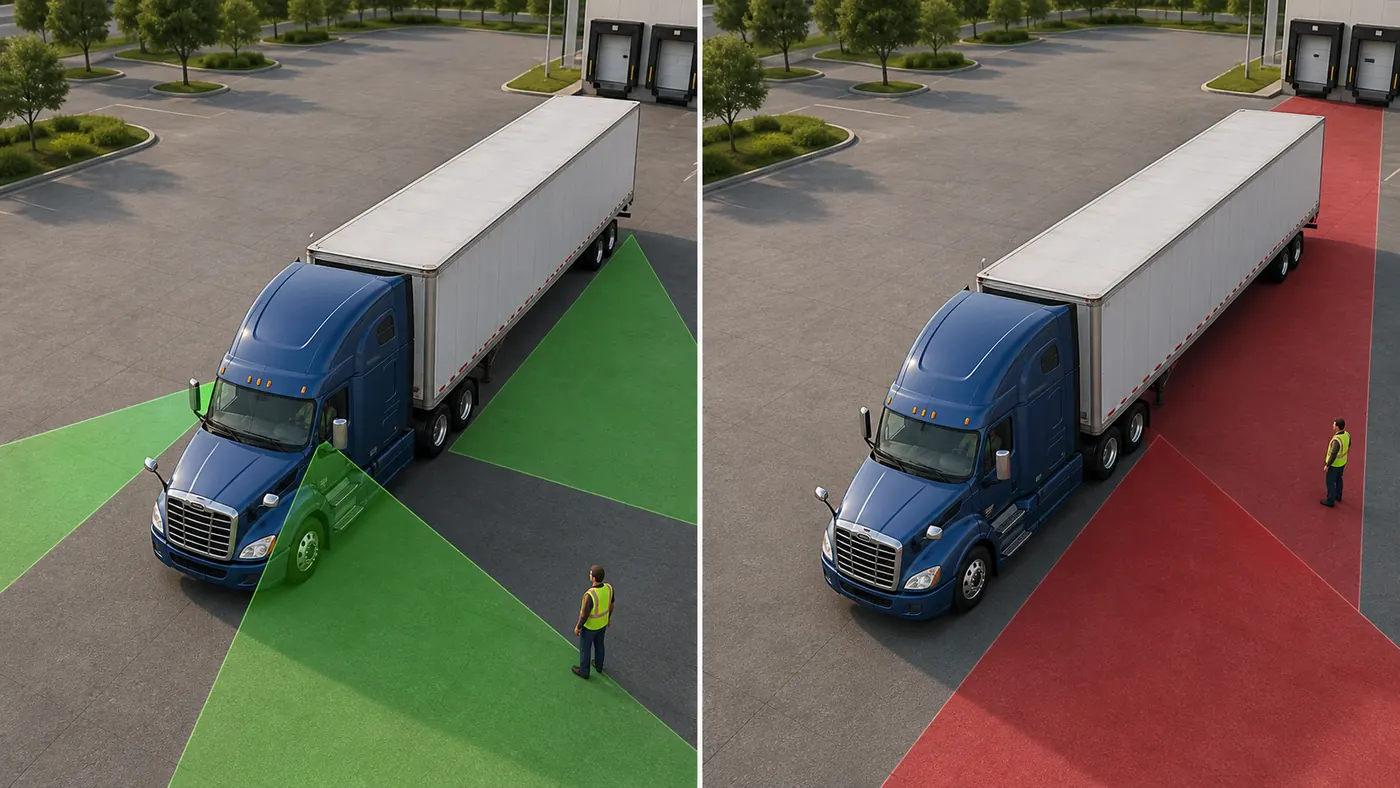
Whenever you have a choice, try to arrange the maneuver so you are backing toward the driver's side.
This gives you better visibility through the driver's window and mirror.
Passenger-side backing is sometimes called blind-side backing because visibility is significantly more limited.
Official CDL guidance recommends backing toward the driver's side whenever possible because the driver can see the rear of the vehicle more effectively.
Sometimes choosing driver-side backing may require:
- Driving around the parking lot
- Approaching from another direction
- Passing the space and turning around
That small amount of extra driving can make the parking maneuver much easier.
6. Set Up the Truck Correctly
A good parking maneuver usually starts with a good setup.
Many backing problems begin before the truck ever goes into reverse.
Try to position the tractor and trailer so the truck has:
- Enough room to turn
- A manageable trailer angle
- Good visibility
- Enough space in front of the tractor
- A clear path into the parking spot
If your setup is poor, do not force the truck into the space.
Reset.
Drive forward, reposition, and try again.
Experienced drivers know that spending another 20 or 30 seconds creating a better setup can save several minutes of difficult corrections afterward.
7. Understand How the Trailer Moves
Backing a trailer feels unnatural to many new drivers.
When backing, the trailer initially moves opposite the direction of the steering input. Once the trailer begins turning, the driver must adjust the steering to follow and control the trailer.
Official CDL guidance explains this relationship and recommends correcting trailer drift as soon as it becomes visible.
The key is to make small steering corrections.
Large steering movements can quickly create too much trailer angle.
If the trailer starts going somewhere you do not want it to go:
- Stop.
- Correct the steering.
- Move slowly.
- Watch how the trailer responds.
Do not wait until the trailer is badly out of position.
Small problems are easier to fix than large ones.
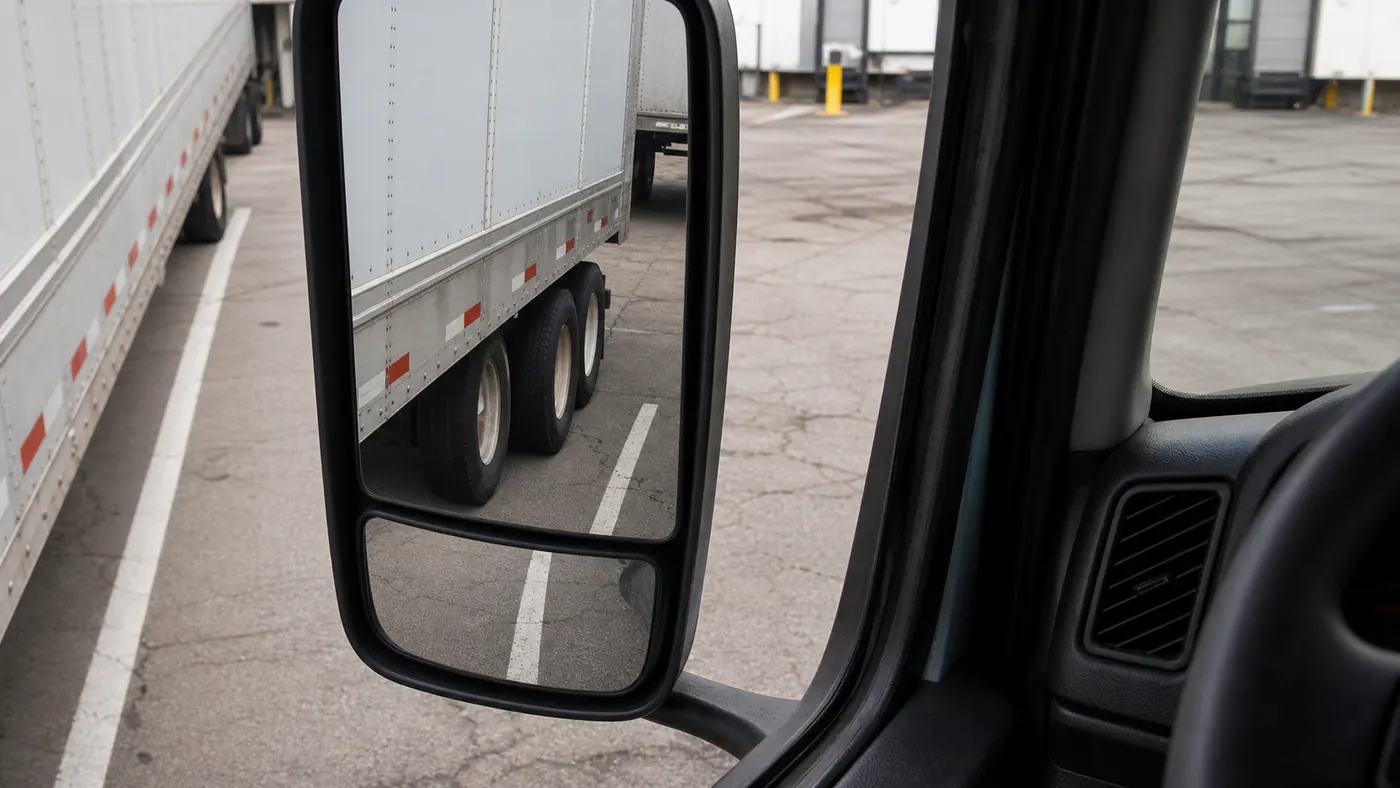
8. Watch the Trailer Tires
Mirrors provide a lot of information, but one of the most useful reference points is the trailer's rear wheels.
Watching the trailer tires can help you understand:
- Where the trailer is going
- How close you are to parking lines
- Whether the trailer is turning too sharply
- Whether the trailer is approaching a curb or obstacle
When backing toward a dock, the trailer tires can also help you judge whether the trailer is becoming aligned with the dock.
Learning to use consistent reference points makes backing much easier.
9. Make Small Steering Corrections
New drivers often oversteer.
The trailer begins moving slightly in the wrong direction, so the driver turns the steering wheel aggressively.
Then the trailer moves too far in the opposite direction.
The driver corrects again.
Soon the entire maneuver becomes a series of large corrections.
Instead:
- Make a small correction.
- Wait for the trailer to respond.
- Reevaluate.
- Correct again if necessary.
Remember that there is a delay between your steering input and what happens at the back of a 53-foot trailer.
Smooth inputs usually produce smoother backing.
10. Do Not Be Afraid to Pull Up
A pull-up means stopping the backing maneuver, moving forward, and repositioning the truck.
Some new drivers view pulling forward as a failure.
It is not.
Pull-ups are a normal part of parking tractor-trailers.
If your trailer becomes:
- Too angled
- Too close to another truck
- Too close to a curb
- Misaligned with the space
Pull forward and fix the position.
Trying to rescue a bad angle while continuing backward often makes the maneuver harder.
Even CDL basic-control tests recognize pull-ups as a normal correction technique, although excessive corrections may affect scoring during the test.
On the road, the priority is not test scoring.
The priority is avoiding an accident.
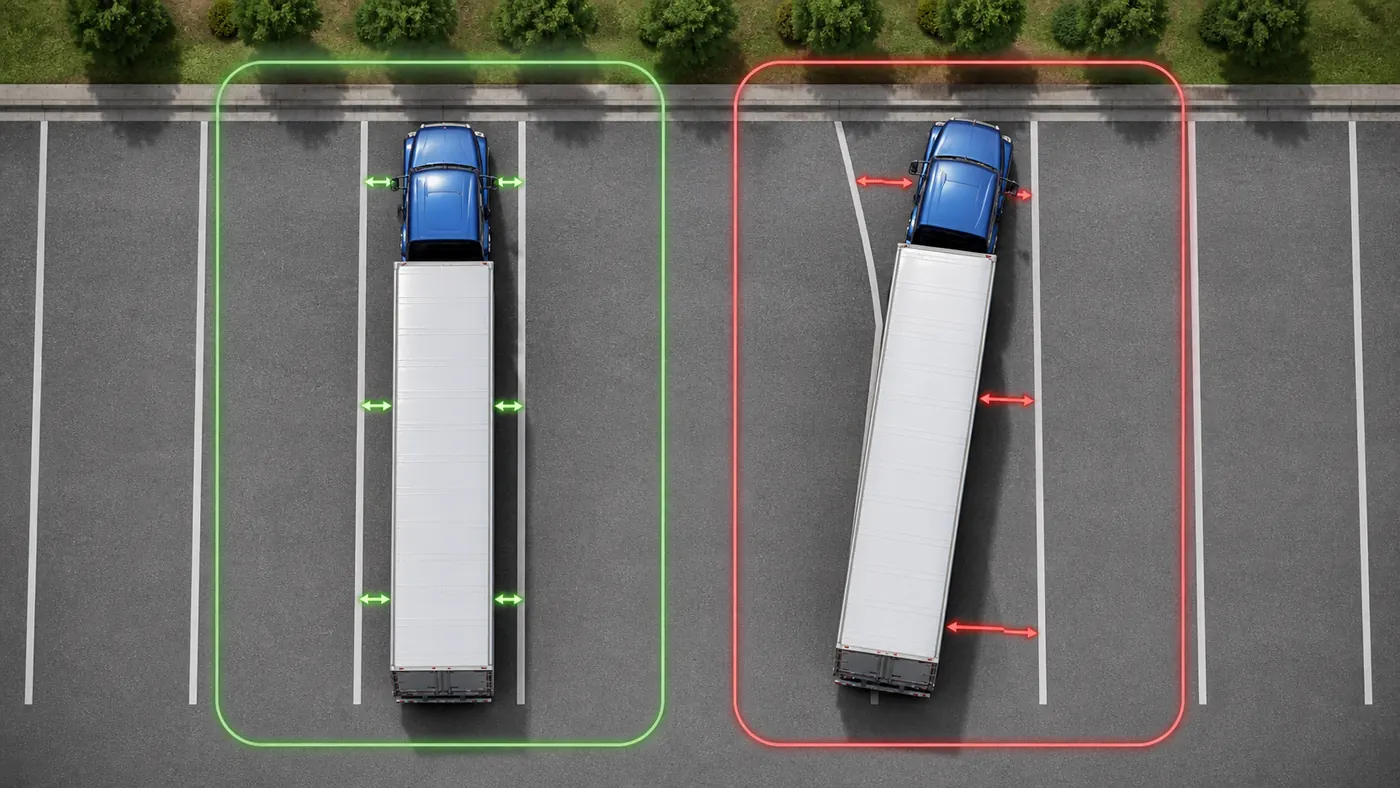
11. Avoid Excessive Trailer Angle
When the tractor and trailer create a very sharp angle, visibility becomes worse and the maneuver becomes more difficult.
If the angle continues increasing, you can approach a jackknife position.
When you notice the angle becoming uncomfortable:
Stop → pull forward → straighten the combination → try again.
Trying to force the trailer into position from a bad angle can lead to:
- Trailer damage
- Tractor damage
- Contact with another vehicle
- Damage to air or electrical lines in extreme situations
Maintaining control of the angle is one of the fundamental skills of backing a tractor-trailer.
12. Watch the Front of the Tractor
Backing does not mean you only need to watch the trailer.
As you turn the steering wheel, the front of the tractor swings in the opposite direction.
This is especially important in crowded truck stops.
Your trailer may have plenty of clearance while the tractor's:
- Hood
- Bumper
- Fender
- Mirror
moves toward another parked truck.
Continue checking your front clearance throughout the maneuver.
Many parking accidents occur because a driver becomes so focused on the trailer that they forget about tractor swing.
13. Use a Spotter When Available
A reliable spotter can help during difficult backing situations.
The spotter may help watch areas that the driver cannot see.
Before starting, agree on:
- Hand signals
- Where the spotter will stand
- The stop signal
- What the driver should do if the spotter disappears from view
Official CDL guidance recommends using a helper when possible and making sure the helper remains where the driver can see them.
A critical rule is:
If you lose sight of the spotter, stop the truck.
Never assume they have moved out of the way.
14. Turn Off Distractions
Backing requires concentration.
Before beginning a difficult maneuver:
- Lower the radio volume
- Stop unnecessary phone conversations
- Put the phone away
- Open the window if it helps
- Focus completely on the truck
Some drivers also turn off cabin fans or other noise sources temporarily so they can hear horns, warning shouts, or unusual sounds around the vehicle.
Parking may only take a few minutes.
Give it your full attention.
15. Be Extra Careful at Truck Stops
Truck stops present unique parking challenges.
There may be:
- Trucks entering and leaving
- Drivers walking between vehicles
- Trucks fueling
- Drivers opening doors
- Delivery vehicles
- Cars
- Poor lighting
- Narrow lanes
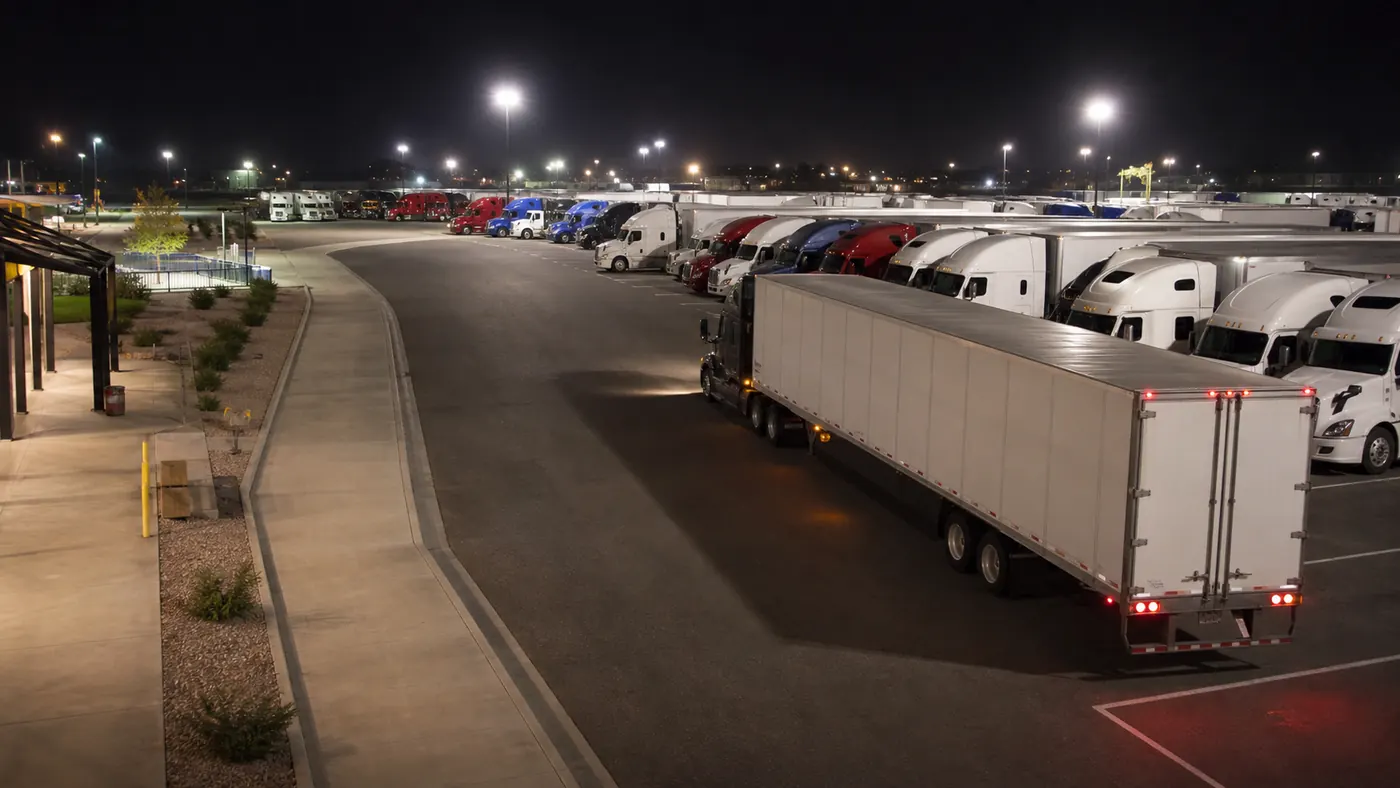
At night, truck stops can become particularly crowded.
The Federal Highway Administration recognizes truck parking shortages as a nationwide safety concern, with demand often exceeding available capacity in some locations, particularly during overnight periods.
This is one reason trip planning and early parking decisions are so important.
When Entering a Truck Stop
Slow down immediately.
Look for:
- Available spaces
- Traffic direction
- Trucks backing
- Pedestrians
- Fuel-island congestion
Never assume another truck driver sees you.
When Choosing a Space
When possible, choose a space with:
- Good lighting
- Enough width
- Enough maneuvering space
- No obvious obstacles
- Easy exit access
A slightly longer walk to the building is better than squeezing into an unnecessarily difficult space.
16. Park Earlier When Possible
Parking availability often decreases later in the day.
If your route and Hours of Service allow it, waiting until the last possible minute to search for parking can make your day much more difficult.
Instead, plan ahead.
Identify:
- Primary parking location
- Backup truck stop
- Nearby rest areas
- Company terminals
- Approved customer parking
FHWA research has repeatedly identified truck parking shortages and notes that inadequate parking can contribute to drivers using unsafe or unofficial locations.
A good trip plan should therefore include parking before you begin the day's driving.
Do not wait until you have only a few minutes left on your clock.
17. Avoid Parking in Unsafe or Unauthorized Areas
When official spaces are full, it can be tempting to park wherever the truck physically fits.
That can create serious problems.
Avoid locations such as:
- Highway shoulders
- Active entrance ramps
- Active exit ramps
- Fire lanes
- Areas marked "No Parking"
- Locations blocking traffic
- Unauthorized private property
- Areas where the trailer extends into a travel lane
FHWA identifies parking on highway shoulders, ramps, and other unofficial locations as a safety concern associated with shortages of designated truck parking.
Always verify that overnight truck parking is legally permitted.
Rules can vary by state, municipality, property owner, and facility.
18. Be Careful Parking Beside Other Trucks
If you have several available spaces, avoid choosing the most difficult one unless there is a reason to do so.
A space between two trucks creates less margin for error than several empty spaces together.
When parking beside another tractor-trailer:
- Watch both mirrors.
- Maintain clearance on both sides.
- Watch your trailer swing.
- Watch your tractor swing.
- GOAL when unsure.
Also remember that neighboring trucks may leave before you do.
Try not to park so close that another driver cannot safely access their truck or exit the space.
19. Leave Yourself Enough Space to Exit
Think about tomorrow morning when choosing your space tonight.
A parking location may be easy to enter when the lot is empty but extremely difficult to leave after other trucks arrive.
Whenever possible, consider:
- Where another truck may park
- Whether someone could block your turning area
- How much tractor swing you will need
- Whether you can pull forward when leaving
Commercial-driver guidance recommends avoiding unnecessary backing when possible and suggests parking in a way that allows the driver to pull forward when departing.
That can reduce risk considerably.
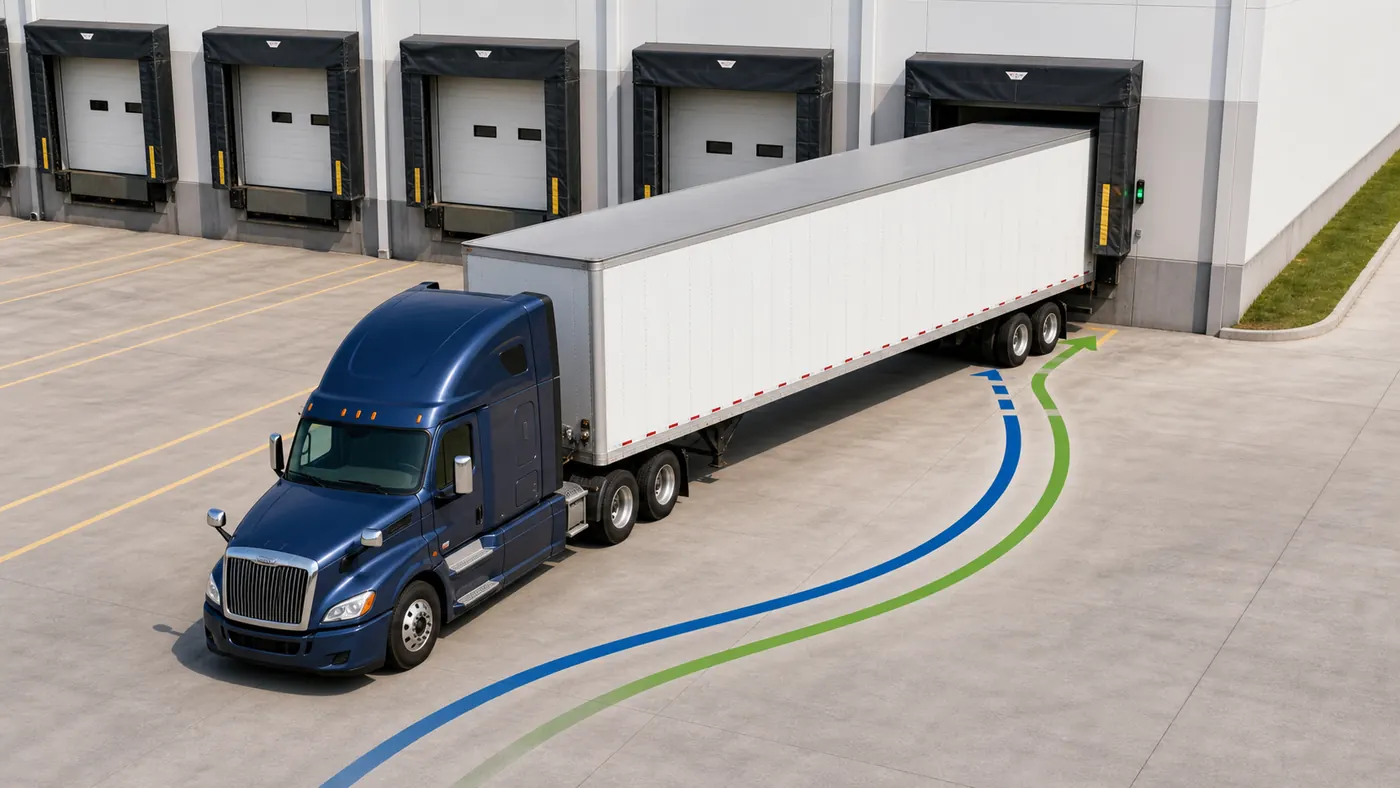
20. Parking at a Loading Dock
Backing into a warehouse dock is one of the most common maneuvers in trucking.
Before backing:
- Confirm the correct dock number.
- Look at the dock area.
- Check for pedestrians and forklifts.
- Inspect for poles, barriers, and parked trailers.
- Position the tractor correctly.
- Begin backing slowly.
As you approach:
- Use both mirrors.
- Keep the trailer centered.
- Watch trailer tires.
- Make small corrections.
- Stop and GOAL if necessary.
Never assume a dock area is completely clear simply because warehouse personnel told you to back in.
The driver is still responsible for controlling the vehicle.
21. Straight-Line Backing
Straight-line backing is one of the most basic commercial driving skills.
The goal is to keep the tractor and trailer aligned while moving backward.
Use both mirrors and watch for the trailer beginning to drift.
Make small corrections immediately.
Do not allow a small drift to become a large one.
Straight-line backing provides a foundation for more advanced maneuvers and is part of basic CDL vehicle-control training.
Practice it whenever you have access to a safe training area.
22. Offset Backing
Offset backing involves moving the truck from one lane or position into another while reversing.
This maneuver requires more steering control than straight-line backing.
The general process involves:
- Creating the initial trailer angle.
- Allowing the trailer to move toward the new position.
- Following the trailer with the tractor.
- Straightening the combination.
- Making final adjustments.
Offset backing is also among the basic control skills used in CDL testing frameworks.
The exact test procedures can differ, so drivers preparing for a CDL exam should follow their state's current manual and examiner instructions.
23. Alley Dock Backing
An alley-dock-style maneuver simulates backing into a loading area positioned at an angle from the truck.
This type of backing requires careful coordination between:
- Tractor position
- Trailer angle
- Steering corrections
- Mirror use
- Pull-ups
Do not try to memorize only one steering-wheel formula.
Real parking lots are different from CDL training courses.
Instead, learn to understand what the trailer is doing and how your steering affects it.
That skill transfers to real-world situations.
24. Night Parking Requires Extra Attention
Backing becomes more difficult after dark.
Problems include:
- Reduced depth perception
- Dark trailers
- Poorly marked parking lines
- Glare from headlights
- Pedestrians wearing dark clothing
- Hard-to-see obstacles
Before backing at night:
- Clean your mirrors.
- Make sure backup and work lights function.
- Slow down.
- Look around the space before entering.
- GOAL more often when necessary.
Never rely only on shadows or lights reflected from neighboring trailers to estimate distance.
If you cannot determine clearance, physically check it.
25. Be Careful in Rain, Snow, and Ice
Bad weather creates additional parking challenges.
Rain can reduce visibility through mirrors.
Snow can cover:
- Parking lines
- Curbs
- Wheel stops
- Potholes
- Obstacles
Ice can cause the tractor or trailer to slide during maneuvering.
Slow down even more than usual.
If necessary, get out and inspect the area before committing to the space.
Also remember that snow piles can reduce the effective size of a parking lot and make tractor swing more difficult.
26. Secure the Truck After Parking
Once the truck is properly positioned:
- Come to a complete stop.
- Set the parking brakes.
- Place the transmission in the appropriate position according to the vehicle and company procedure.
- Confirm that the truck will remain stationary.
Parking brakes must be capable of keeping the vehicle from moving when parked, particularly on a grade.
If parking on a slope or unusual surface, follow the applicable vehicle, company, and regulatory procedures.
Before leaving the cab, make sure the vehicle is properly secured.
27. Check Your Final Position
Before walking away from the truck, look at how it is parked.
Ask yourself:
- Am I inside the parking lines?
- Is the trailer straight enough?
- Is there enough clearance on both sides?
- Is the tractor blocking the travel lane?
- Can neighboring trucks leave?
- Is any part of my trailer creating a hazard?
- Will I be able to leave safely?
If the position is poor, fix it now.
Do not leave a badly parked truck simply because you are tired.
Common Semi-Truck Parking Mistakes
Even experienced drivers can make mistakes when they become tired, distracted, or rushed.
Backing Too Fast
Speed reduces the time available to recognize and correct problems.
Watching Only One Mirror
The opposite side of the trailer can move dangerously close to an obstacle.
Refusing to GOAL
Trying to guess a clearance from the cab can turn a simple maneuver into an accident.
Oversteering
Large steering corrections can quickly create an excessive trailer angle.
Continuing From a Bad Setup
Sometimes starting over is easier than trying to save a poor approach.
Forgetting Tractor Swing
Drivers may focus on the trailer and hit something with the front of the tractor.
Letting Other Drivers Rush You
A driver waiting behind you may become impatient.
That does not mean you should speed up.
Take the time required to park safely.
Parking Somewhere You Cannot Easily Exit
Always think about how you will leave the space later.
Semi-Truck Parking Checklist
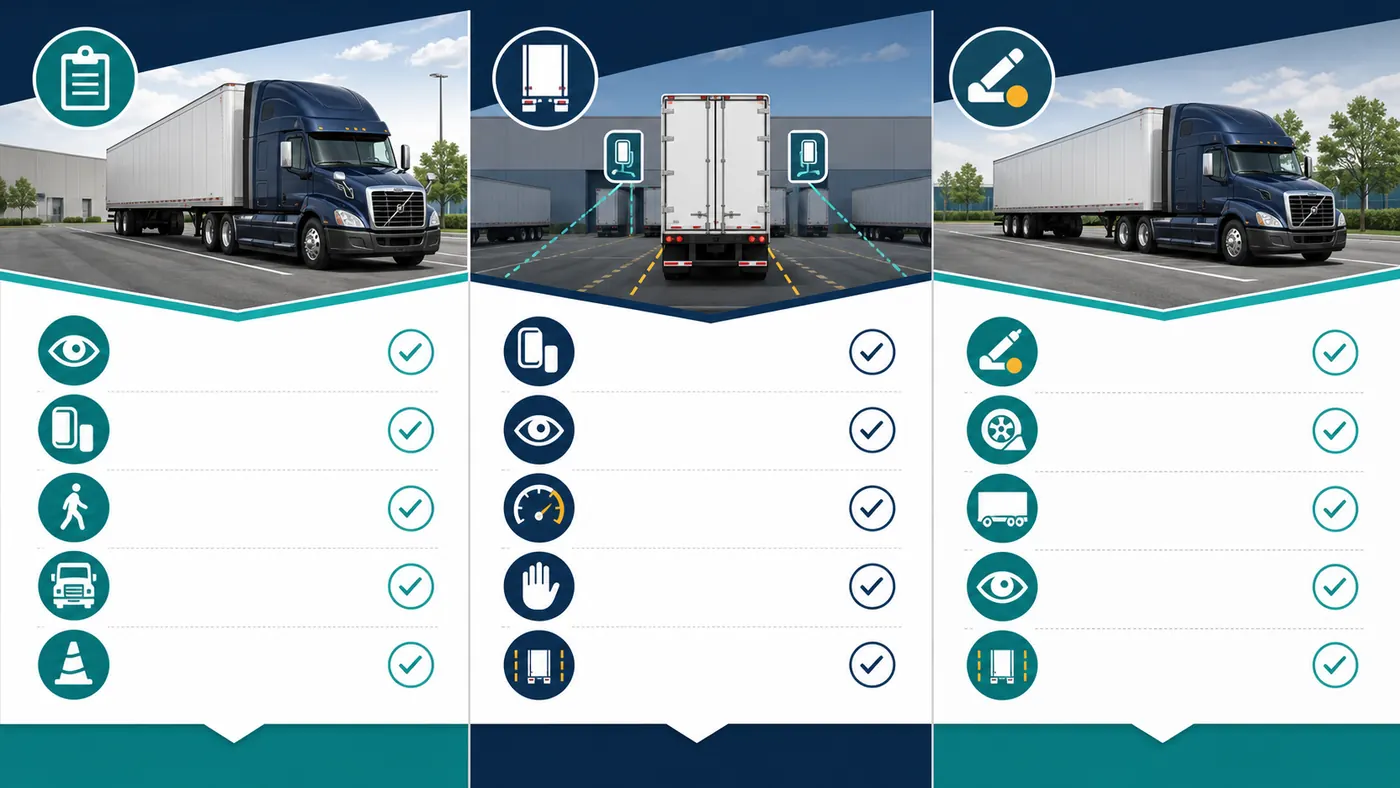
Before backing:
- Check the entire area.
- Identify obstacles.
- Check overhead clearance.
- Look for pedestrians.
- Choose driver-side backing when possible.
- Create a good setup.
While backing:
- Move slowly.
- Check both mirrors.
- Watch trailer tires.
- Monitor tractor swing.
- Make small corrections.
- Pull forward when necessary.
- GOAL whenever unsure.
After parking:
- Straighten the tractor and trailer.
- Stay within the parking area.
- Set the parking brakes.
- Check clearance on both sides.
- Make sure you are not blocking traffic.
- Confirm that you can safely leave later.
How New Truck Drivers Can Improve Their Parking Skills
The best way to improve is practice.
Whenever you have access to a large, safe, legal practice area, work on:
- Straight-line backing
- Driver-side backing
- Offset backing
- Dock approaches
- Trailer control
- Mirror reference points
Do not practice complicated backing maneuvers in crowded truck stops simply because you want more experience.
Use appropriate training areas whenever possible.
Pay attention to what happens when you make different steering inputs.
Eventually, you will begin to recognize trailer movement earlier.
That is when backing becomes much easier.
Do Experienced Drivers Still GOAL?
Absolutely.
Experience does not eliminate blind spots.
A driver with decades of experience still cannot see through a trailer.
Professionalism means recognizing when you do not have enough information and checking before continuing.
Getting out of the truck several times may take a few minutes.
Repairing a damaged truck can take hours or days.
What Should You Do If the Parking Space Feels Too Difficult?
Choose another space if one is available.
There is no prize for successfully parking in the hardest spot in the lot.
If the space has:
- Extremely limited clearance
- Poor lighting
- Unusual obstacles
- Insufficient tractor swing
- Dangerous traffic
look for a safer alternative.
Good professional driving is not about proving that you can force the truck into every available gap.
It is about making good decisions.
Final Thoughts
Parking a semi-truck takes patience, practice, and careful observation.
The most important principles are straightforward:
Set up correctly. Back slowly. Use both mirrors. Make small corrections. Pull forward when necessary. Get out and look whenever you are unsure.
Whenever possible, choose driver-side backing and position the truck so you can pull forward when leaving.
At busy truck stops, plan parking before your available driving time becomes critically low. At loading docks, inspect the area before backing. At night or in bad weather, reduce your speed and increase your caution.
Most importantly, never let another driver, dispatcher, customer, or your own frustration pressure you into rushing a backing maneuver.
Taking another minute to reposition the truck is much better than spending hours completing an accident report.
With practice, parking becomes easier.
But even after years behind the wheel, the safest truck drivers continue to follow the same basic rule:
If you are not sure — stop, get out, and look.